
Balls (in 10+ dimensions)
A weird fact about ten dimensional balls

Our lived experiences are stuck in three dimensions. Math isn’t. But in higher dimensions, math has a twisted sense of humor.
We’ll start with a simple 2D scenario, then crank up the number of dimensions to see how math scrambles our spatial reasoning.
There is a 4 by 4 box (square) that we want to fill with balls1 of radius 1. These are called unit balls. We do this in the following way.
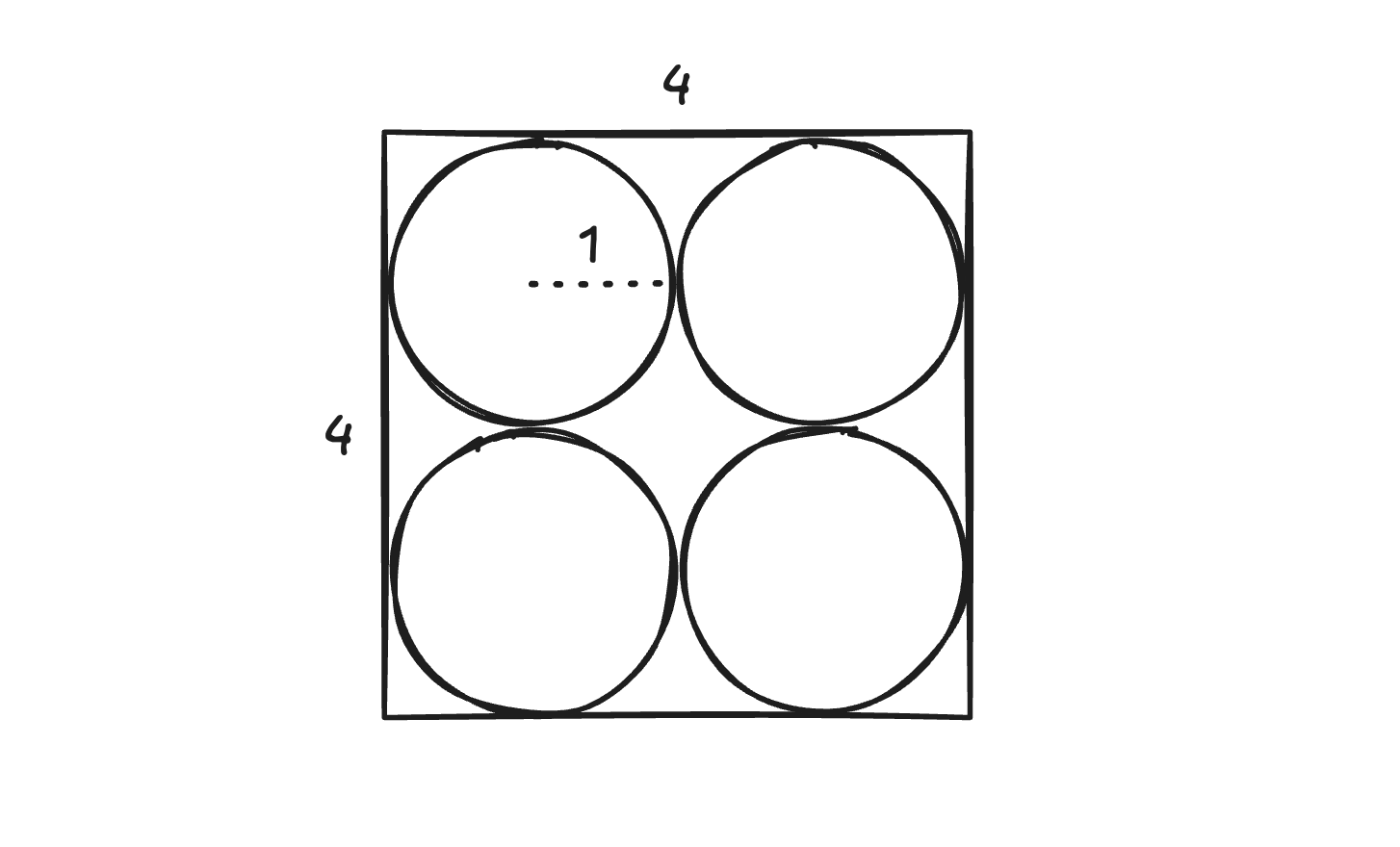
Each corner region of the box gets a unit ball. This naturally gives us 4 unit balls packed tightly into the box.
Now, in the center region between the unit balls, draw a smaller red ball that touches all the unit balls. You can imagine starting at the center point and “blowing up a balloon” until it touches the unit balls, like so:
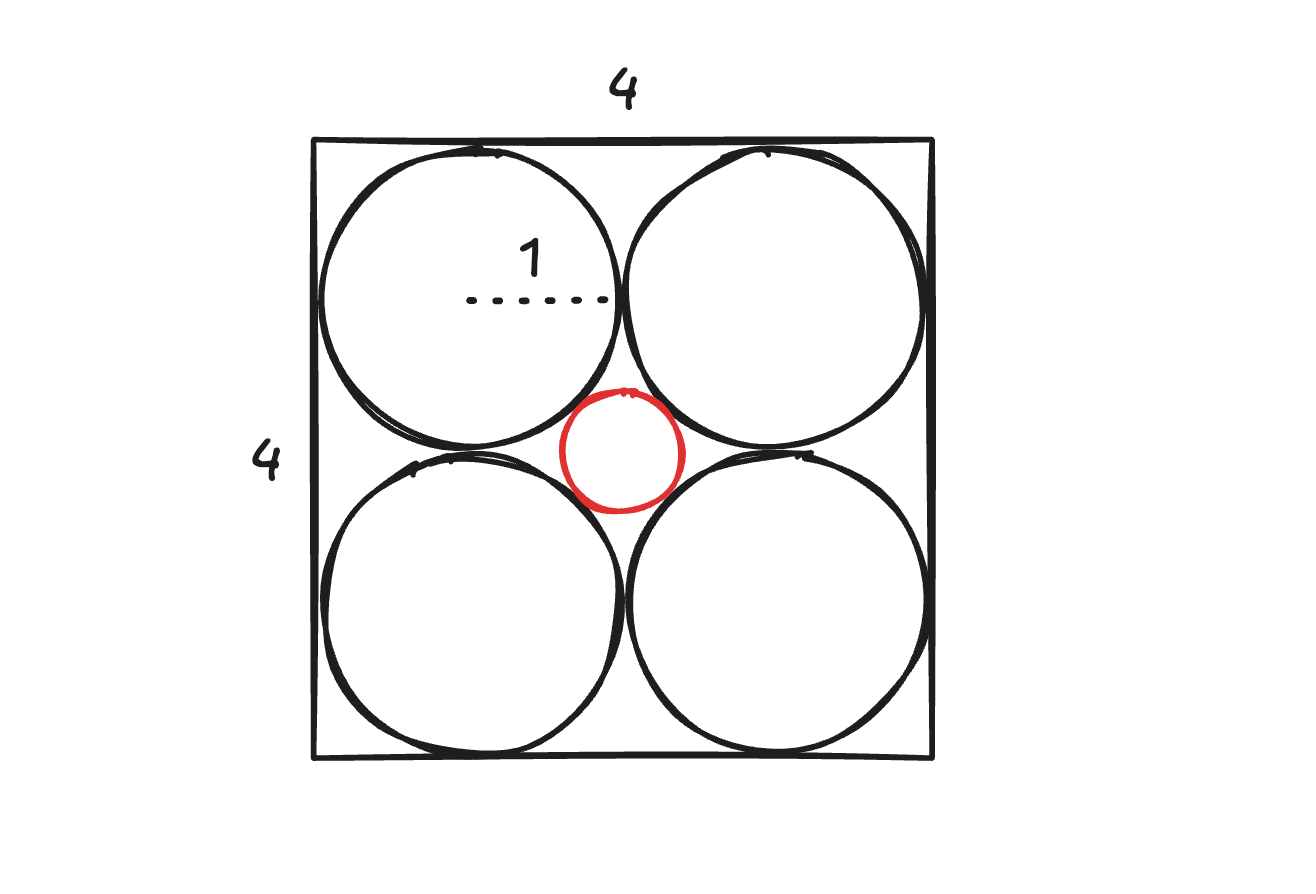
How large is this red ball? What is its radius?
As in many geometry problems, it helps to draw in some guidelines (literally). Let’s draw a diagonal across the box, and view it as the hypotenuse of the right triangle formed by two sides of the box.
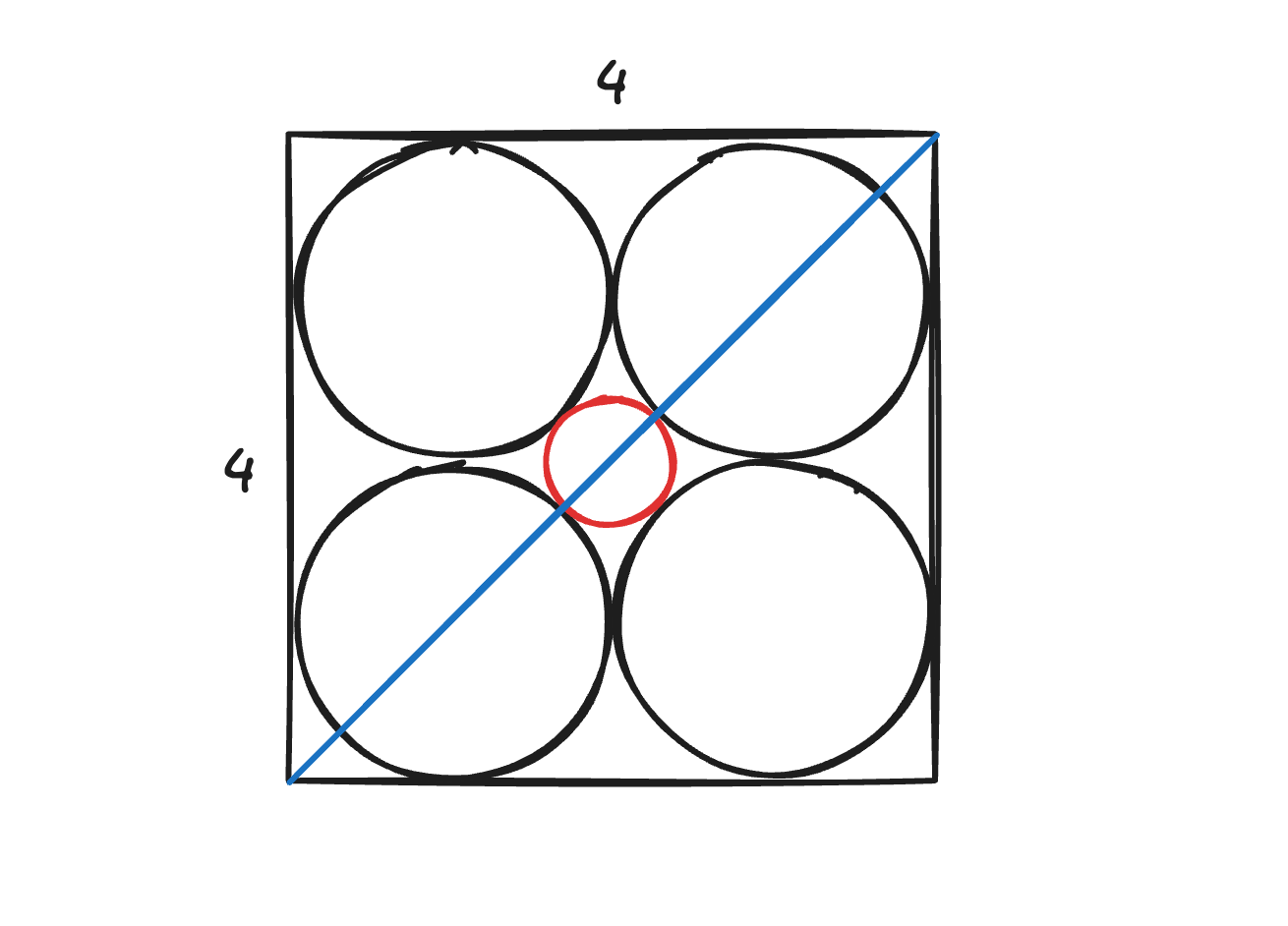
From the Pythagorean Theorem, we know the length of this diagonal is
We can strategically draw in some radii of the unit balls to create the following picture:
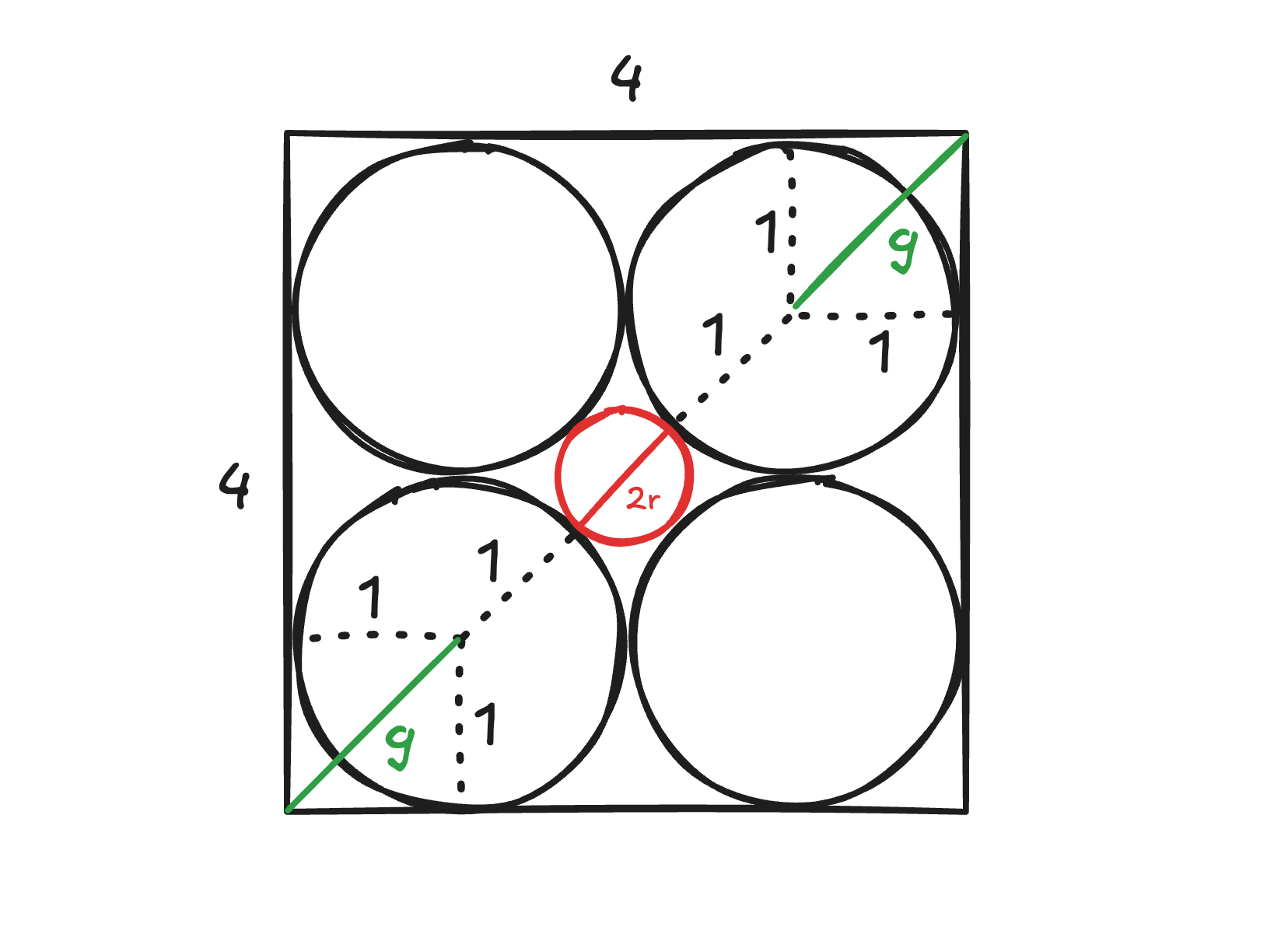
We’ve split the diagonal into more digestible pieces. We can see the diagonal is made up of two of the red ball’s radii (let’s call the red ball’s radius r), two radii of unit balls (each of length 1), and two green lines with unknown length g. Since we know the length of the entire diagonal, we can write down the following equation:
Notice the green lines actually are the diagonal of a smaller 1 by 1 box formed by the radii of the black balls. So, again, by the Pythagorean Theorem, we find that
Plugging this into our previous equation, we can now solve for r, the radius of the red circle.
Imagine scaling this box-and-balls configuration into 3D. Now, you have a cube with 8 unit balls.
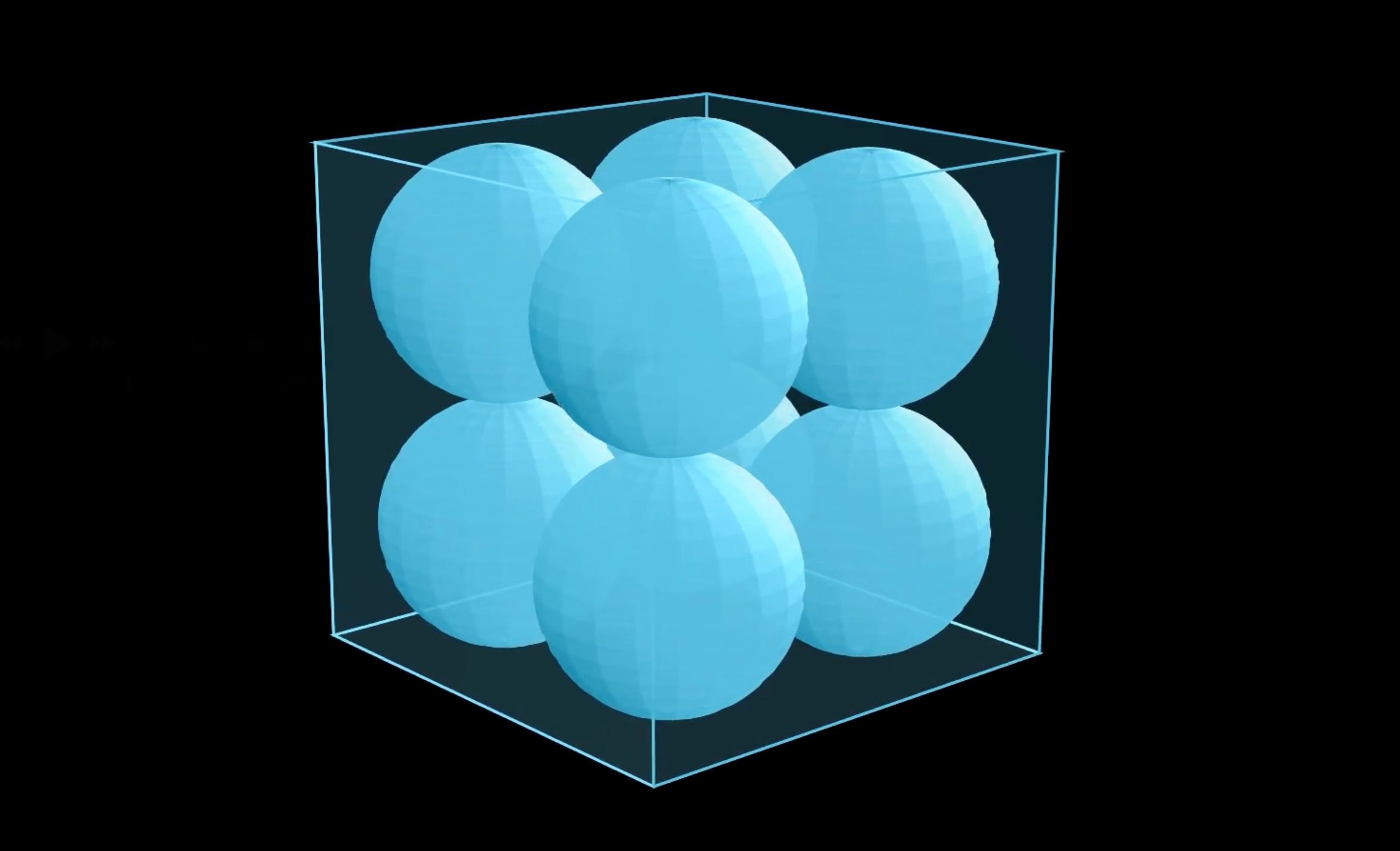
Imagine embedding that same red ball in the tiny space between all 8 unit balls. What is its radius?
Let’s draw in the diagonal of the box and construct a similar equation as in the 2D case. Again, the entire diagonal consists of the diameter of the red ball (2r), two radii of unit balls (each length 1), and two of the green lines (2g).
The length of the 3D box’s diagonal can be calculated by the distance formula (a more general version of the Pythagorean Theorem). If two points differ in x along one dimension, y along another, and z along the last, then the distance between the points is
Since opposite corners of this cube are 4 apart from each other along all dimensions,
We can calculate the length of the green line similarly, since it is the diagonal of the 1 by 1 by 1 box formed by the radii of a unit ball.
Substituting these values into our previous equation, we have
Our 3D ball is actually larger than our 2D ball!
You should begin to see a pattern. In general, the distance formula will tell us that in n dimensions,
So, with the same algebraic logic as before, the radius of the red ball in n dimensions is
This shows us that the radius of the red ball increases as the number of dimensions increases. This is pretty unexpected. Since the number of unit balls in the box doubles every time we add a dimension, it seems like the box gets more “dense” with balls, and thus the space between the unit balls would become smaller and smaller. But the numbers say otherwise.
Here's the punchline: from 10 dimensions onward, the radius of the red ball exceeds 2 (so its diameter exceeds 4). However, the box’s side lengths stay at 4. The red ball’s diameter is longer than the box’s length!
This means, if we could create and visualize this configuration in 10+ dimensions, the red ball would be “poking out” from the sides of the box, and at the same time be fully embedded between unit balls that are fully within the box. Wild.
The word ball is actually a formal mathematical term. Given some center point in space, a ball of radius r around that center point is defined as every point that is within a distance r from the center point. This is slightly different from the mathematical definition of a sphere, which is only the points that are exactly a distance r away from the center point (think of a sphere as only the “shell”). In addition, since circles are usually associated with two-dimensional space and spheres are usually associated with three-dimensional space, using the term “ball” also helps generalize the concept of a “circular object” to higher-dimensional space.
Good read!!
balls and math woaw